
Quick answer: The Blackfyres are the cadet branch of House Targaryen founded by Daemon Blackfyre — the legitimized bastard of Aegon IV — whose five rebellions against the main line bloodied Westeros for over sixty years, from 196 AC to 260 AC. They are, functionally, the “other Targaryens”: same blood, black dragon instead of red, and a grudge that outlived its founder by four generations. See them on the interactive Targaryen family tree.
The Origin: A Deathbed Disaster
Aegon IV — called “the Unworthy,” which tells you how the maesters graded him — spent a lifetime making enemies and bastards. On his deathbed in 184 AC, he made one decision that guaranteed war: he legitimized every one of his bastards at once, including Daemon Waters, his son by his cousin Daena the Defiant (the “princess in the Maidenvault,” Aegon III’s daughter). For the whole brood, see the Great Bastards family tree.
Legitimization alone didn’t make Daemon a claimant — the bastards were placed after the trueborn Daeron II in the succession. But Aegon IV had spent years poisoning that well too: whispering that Daeron was not his son but his brother Aemon the Dragonknight’s, and pointedly giving twelve-year-old Daemon Blackfyre, the Valyrian steel sword of Aegon the Conqueror, when he knighted him — the sword of kings. In Westeros, symbols are claims. Aegon IV handed his bastard both, then died.
The First Rebellion and the Redgrass Field (196 AC)
Twelve years of grievance later — Daemon’s following among martial lords who hated Daeron’s Dornish, bookish court; the rumor machine; the matter of Daenerys, Daeron’s sister, whom Daemon was said to love, married off to the Prince of Dorne — Daemon Blackfyre raised his banner: a black three-headed dragon on red, the colors reversed.
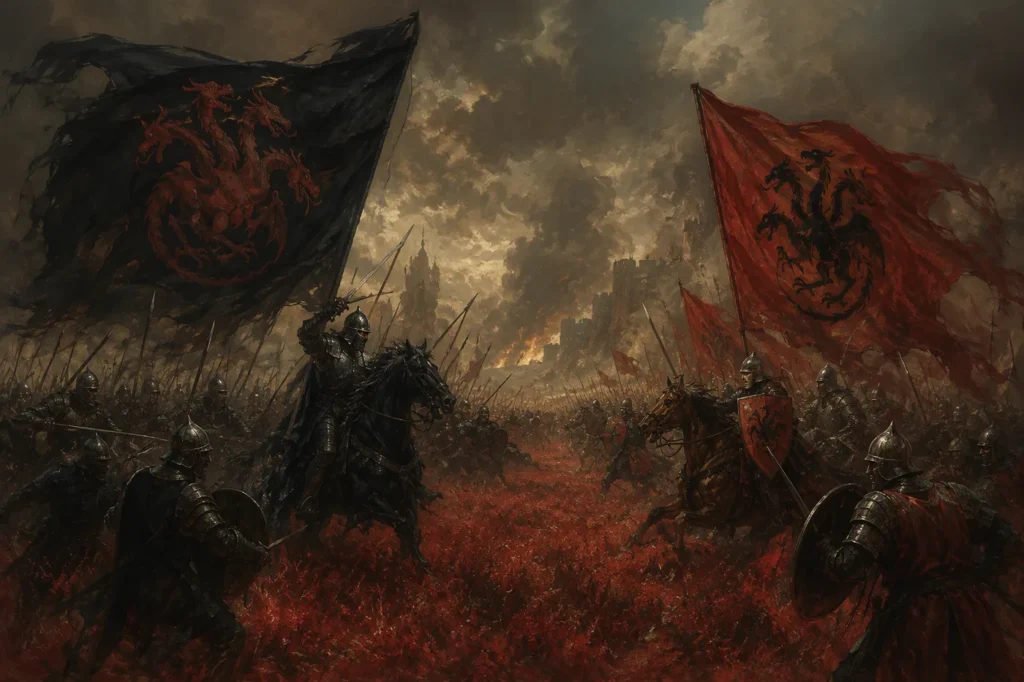
It ended in a single day at the Redgrass Field, in late 196 AC. The loyalists were led by Prince Baelor “Breakspear,” Prince Maekar, Lord Donnel Arryn and Brynden “Bloodraven” Rivers; the rebels by Daemon himself and Aegor “Bittersteel” Rivers. The omens were bad for the rebels before the first charge: Ser Quentyn Ball, one of Daemon’s best generals, was killed by an archer on the eve of battle; Lord Bracken’s hired Myrish crossbowmen were delayed by storms; and Lord Leo Tyrell’s host never arrived in time.
Daemon fought magnificently. He broke Lord Arryn’s van, killed Wyl Waynwood and the Knight of Ninestars, and wounded Ser Gwayne Corbray of the Kingsguard so badly that he was left blind — then stopped to have Gwayne carried to the maesters. Some accounts suggest that pause cost him the day. Meanwhile Bloodraven’s company took the high ground at Weeping Ridge and shot down on Daemon’s position: Bloodraven killed Daemon’s elder twin, Aegon, then Daemon, then the younger twin, Aemon, who had picked up the sword Blackfyre. Bittersteel rallied the fleeing rebels into a charge and cost Bloodraven an eye in single combat, but Baelor struck the rebel rear with stormlords and Dornishmen while Maekar crushed the rest. About ten thousand men died, among them the three sons of a Reach knight named Eustace Osgrey. Bittersteel escaped east with Daemon’s five surviving sons and several of his daughters, and with the sword Blackfyre. The rebellion lost the battle and kept the dynasty.
The Blackfyre Family Tree
Aegon IV "the Unworthy" ═══ Daena the Defiant
        │
Daemon Blackfyre ═══ Rohanne of Tyrosh   († 196 AC, Redgrass Field)
        │
        ├── Aegon (twin)       † 196 AC, Redgrass Field
        ├── Aemon (twin)       † 196 AC, Redgrass Field
        ├── Daemon II          "John the Fiddler" — Second Rebellion (212 AC)
        ├── Haegon I           Third Rebellion († 219 AC)
        │     └── Daemon III   Fourth Rebellion († 236 AC)
        ├── Aenys              killed under safe conduct (233 AC)
        ├── Calla              promised to Bittersteel
        └── (other sons and daughters)

Maelys "the Monstrous" — last Blackfyre claimant, Fifth Rebellion († 260 AC);
his exact descent is not recorded
The Five Rebellions
| # | Year | Blackfyre claimant | Outcome |
|---|---|---|---|
| First | 196 AC | Daemon Blackfyre | Redgrass Field — Daemon and his twin sons killed |
| Second | 212 AC | Daemon II (disguised as “John the Fiddler”) | Exposed at Whitewalls before it began — Bloodraven’s army arrived and Daemon II was arrested (see The Mystery Knight) |
| Third | 219 AC | Haegon I, then Daemon III | Haegon died; Bittersteel was arrested and sent toward the Wall — and freed when the Golden Company attacked his ship |
| Fourth | 236 AC | Daemon III | Defeated at the Wendwater Bridge; Daemon III killed — Bittersteel’s last war |
| Fifth | 258–260 AC | Maelys the Monstrous | The War of the Ninepenny Kings — ended in the Stepstones when Barristan Selmy killed Maelys |
Aenys and the Great Council of 233 AC
The Blackfyre cause tried words once. In 233 AC King Maekar I died in the Peake Uprising, leaving the succession unclear, and his Hand — Brynden Rivers — called a Great Council in King’s Landing. The candidates were Daeron the Drunken’s daughter Vaella, Aerion’s infant son Maegor, Prince Aegon — Egg — and a fifth claimant who wrote from Tyrosh hoping to win the throne with words: Aenys Blackfyre, Daemon’s fifth son. Bloodraven offered him safe conduct. Aenys was arrested on arrival and executed in the Red Keep, and his head was shown to the council as a warning to Blackfyre sympathizers.
The lords chose Aegon, who became Aegon V. His first act as king was to arrest Bloodraven for breaking the word of the Iron Throne — and then to offer him the Night’s Watch in place of the headsman.
The End of the Line
The Blackfyre male line died with Maelys the Monstrous in 260 AC. Maelys — whose exact descent isn’t recorded — won command of the Golden Company by killing his own cousin Daemon, then joined the Band of Nine: merchants, mercenaries and pirates from the Free Cities who vowed to help one another carve out kingdoms. They took the Disputed Lands, secured Tyrosh, and then conquered the Stepstones. News of the Band reached King’s Landing in 258 AC; King Jaehaerys II took the throne in 259; and the royal host landed in the Stepstones in 260 AC, with ships under Quellon Greyjoy, a western army under Jason Lannister, and spears from Dorne. The Hand, Lord Ormund Baratheon, was among the first casualties; Gerold Hightower took command; and Prince Aerys — the future Mad King — distinguished himself in the fighting.
Maelys himself was killed in single combat by Barristan Selmy, which is your direct thread to Game of Thrones: the old Kingsguard knight Dany dismisses made his name ending the Blackfyre century. The Golden Company that Bittersteel founded carries the Blackfyre cause into the main books. Whether any blood survives through Daemon’s daughters is the fandom’s favorite open question — and the books have never answered it. Anyone who tells you they know is selling something.
Why the Blackfyres Matter
The Blackfyre era is the connective tissue between the Dance of the Dragons and the Dunk and Egg stories — and it’s the reason the court Egg grows up in is paranoid, purged, and poor. Every suspicious hedge knight, every executed claimant, every drought-strained lord in The Sworn Sword and The Mystery Knight is downstream of Aegon IV’s deathbed. You can trace the whole collision on the interactive Targaryen family tree.
FAQ
Who are the Blackfyres?
A legitimized-bastard branch of House Targaryen founded by Daemon Blackfyre, son of Aegon IV. They claimed the Iron Throne and launched five rebellions across sixty years.
How many Blackfyre rebellions were there?
Five: 196, 212, 219, 236, and 258–260 AC. Only the first came close to succeeding.
Are there any Blackfyres left?
The male line is canonically extinct — Maelys the Monstrous, killed by Barristan Selmy in 260 AC, was the last. The female line is unaccounted for, and the books have never resolved it.
What happened to the sword Blackfyre?
Bittersteel carried it east after the Redgrass Field. Its whereabouts after the Fourth Rebellion are unknown — one of the great dangling threads of the era.
Is House Blackfyre in A Knight of the Seven Kingdoms?
Constantly, as background radiation: Eustace Osgrey fought for Daemon, and The Mystery Knight (the third novella) is built around the Second Blackfyre Rebellion.
Who killed Daemon Blackfyre?
Brynden “Bloodraven” Rivers. His company took the high ground at Weeping Ridge, and he shot down Daemon and both of his twin sons, Aegon and Aemon, at the Redgrass Field in 196 AC.
Why did Daemon Blackfyre lose at the Redgrass Field?
Bad luck and archers: his best general Quentyn Ball was killed on the eve of battle, allied hosts arrived late or not at all, and Daemon stopped to have a wounded Kingsguard knight carried to the maesters while Bloodraven’s company took Weeping Ridge.
Who killed Maelys the Monstrous?
Ser Barristan Selmy, in single combat in the Stepstones, ending the War of the Ninepenny Kings in 260 AC.
Related Pages
- The Great Bastards family tree
- Brynden “Bloodraven” Rivers
- Aegor “Bittersteel” Rivers and the Golden Company
- Daeron II Targaryen
- What happens to Dunk and Egg after Season 2?