Quick answer: The Targaryen royal line —
the name, the crown, the family as a ruling house — effectively ends
with the finale: Daenerys dead, Jon exiled beyond the Wall with no
interest in fathering heirs. But the bloodline? Oh, the
bloodline is everywhere. It’s hiding in House Baratheon, it rules Dorne,
and it’s scattered across Essos like dragonseed. The name dies. The
blood doesn’t. Let’s walk it on the family tree.
The Official
Ending: A Dynasty Reduced to One Exile
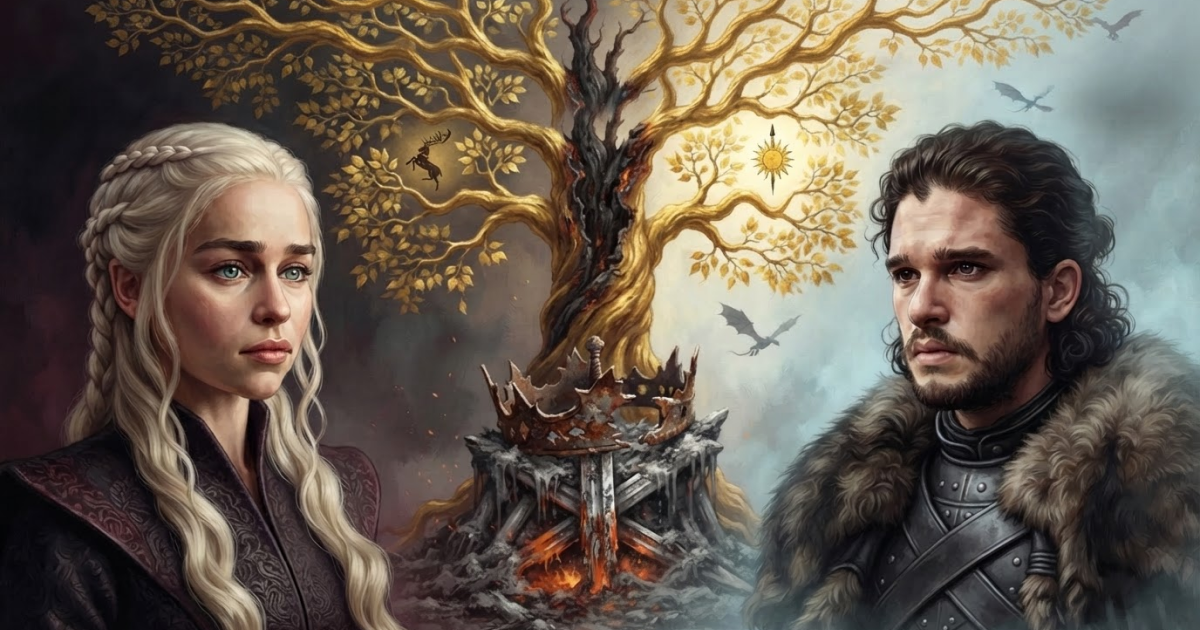
Let’s recap where the story leaves House Targaryen, because it’s
genuinely bleak. Daenerys — the last acknowledged Targaryen — is killed
by Jon Snow in the ruins of King’s Landing. Her last living dragon,
Drogon, melts the Iron Throne (symbolism: not subtle) and flies east
with her body.
And Jon? Jon is secretly Aegon Targaryen, the legitimate son
of Rhaegar — but the world doesn’t know that, and Jon has precisely zero
interest in pressing the claim. He’s sent back to the Night’s Watch and
promptly walks off beyond the Wall with the Free Folk, where — and we
cannot stress this enough — a man swearing off the world and vanishing
into a frozen forest is not a man planning a nursery.
So: no acknowledged Targaryens, no Targaryen children, no Targaryen
claimants. Three hundred years of dragonlords, gone in a generation. If
you’re asking “does the bloodline end?” the honest court answer is:
House Targaryen, as a house, ends.
But this family has never been good at staying extinct.
Branch One: The Baratheons
(Yes, Really)
Here’s the fun one, because it means Robert’s Rebellion was —
technically — a family dispute.
King Aegon V (Egg himself) had a daughter,
Rhaelle Targaryen, who married Ormund Baratheon. Their
son was Steffon Baratheon. And Steffon’s sons were Robert,
Stannis, and Renly. That’s right: Robert Baratheon’s
grandmother was a Targaryen princess. It’s exactly why the rebels put
Robert on the throne instead of Ned or Jon Arryn — the maesters could
point at his family tree and say “see? Dragon blood. Totally
legitimate.”
Now follow it forward: the show ends with Gendry,
Robert’s son, legitimized as Lord of Storm’s End — legitimized by
Daenerys herself, which is a beautifully incestuous piece of irony. So
the “Targaryen bloodline” doesn’t just survive the finale; it survives
in the Baratheon line that Daenerys personally restored. You
could not make this up. (We mapped the whole thing here: How
Is Robert Baratheon Related to the Targaryens?)
Oh, and bonus round: Orys Baratheon, the founder of House Baratheon,
was rumored to be Aegon the Conqueror’s bastard half-brother.
Which means the Baratheons may have had dragon blood since literally day
one.
Branch Two: The Martells of
Dorne
Back in 187 AC, Daenerys Targaryen — not that one,
the daughter of Aegon IV — married Prince Maron Martell, finally
bringing Dorne into the Seven Kingdoms with a marriage instead of a war.
Every Martell after that descends from her. Doran, Oberyn, Arianne,
Trystane: all carriers of the blood of the dragon.
The Red Viper’s family tree has silver-haired royalty in it. This is
also, not coincidentally, why the Martells kept signing secret Targaryen
marriage pacts (Viserys and Arianne, per the books) — they weren’t just
allies, they were family, and Dorne never forgets.
Branch Three:
The Blackfyres and the Dragonseeds
House Blackfyre — founded by Daemon Blackfyre, the legitimized
bastard son of Aegon IV — spent a century launching rebellions for the
Iron Throne. The male line died out in 260 AC when Maelys the Monstrous
was killed by young Ser Barristan Selmy… but the female line? Never
accounted for. Somewhere in Essos, Blackfyre blood may still be
circulating, and book readers have strong opinions about exactly where
(hello, Young Griff).
Then there are the dragonseeds — the countless Targaryen bastards
scattered through history. The Plumms of Westeros carry a drop (“Brown
Ben Plumm” of the Second Sons claims two). Half of Dragonstone’s
smallfolk claimed dragon blood during the Dance, and some of them — the
dragonseed riders like Hugh Hammer and Ulf White — proved it the hard
way.
So… Does It End?
Here’s the verdict, and honestly it’s the most Targaryen answer
possible:
- The house? Gone. The name, the titles, the throne —
done. - The blood? Flowing through Baratheons, Martells,
and a dozen lesser lines on two continents. - The dragons? Drogon is out there somewhere,
unaccounted for, east of everything.
A family that spent three centuries marrying its own siblings to keep
the blood “pure” ended up doing the exact opposite — dissolving into the
bloodstream of the entire world it once ruled. Somewhere, Aegon the
Conqueror is spinning in his grave fast enough to power a windmill.
See every branch for yourself on the interactive Targaryen family
tree.
FAQ
Is Jon Snow the last Targaryen?
Technically, yes —
he’s the last person alive with a Targaryen name-claim (born Aegon
Targaryen, son of Rhaegar). But he’s exiled, has renounced everything,
and shows no interest in children. The last Targaryen is
functionally the end of the house, even though distant relatives carry
the blood.
Do the Baratheons have Targaryen blood?
Yes —
Robert, Stannis, and Renly’s grandmother was Rhaelle Targaryen, daughter
of King Aegon V. Gendry, Robert’s son, carries that blood forward after
the finale.
Could the Targaryen line continue through Jon Snow?
Only if Jon fathers children — and the finale strongly implies he won’t.
The books haven’t reached the ending yet, so this door is technically
open on the page.
What about Daenerys’s dragons — is Drogon still
alive?
Yes, Drogon flew east with Daenerys’s body and is alive
at the end of the series. A living dragon with no rider and no family
tree supervision. What could possibly go wrong.
Does the Targaryen bloodline continue in the books?
The books aren’t finished, and they add wrinkles the show dropped —
including a young man claiming to be Rhaegar’s long-dead son Aegon, plus
the unaccounted Blackfyre female line. On the page, the answer is even
more of a “not necessarily.”