
Quick answer: Brynden Rivers — “Bloodraven” — was the legitimized bastard of Aegon IV and Melissa Blackwood: the spymaster whose archers killed Daemon Blackfyre, the Hand who ran Westeros through two reigns, and, in the books, the same man as the three-eyed crow who teaches Bran Stark beyond the Wall. No character in the franchise spans this much history: he’s born in 175 AC and is still shaping events 125 years later. See his branch on the interactive Targaryen family tree.
The Bastard With the Blood Raven
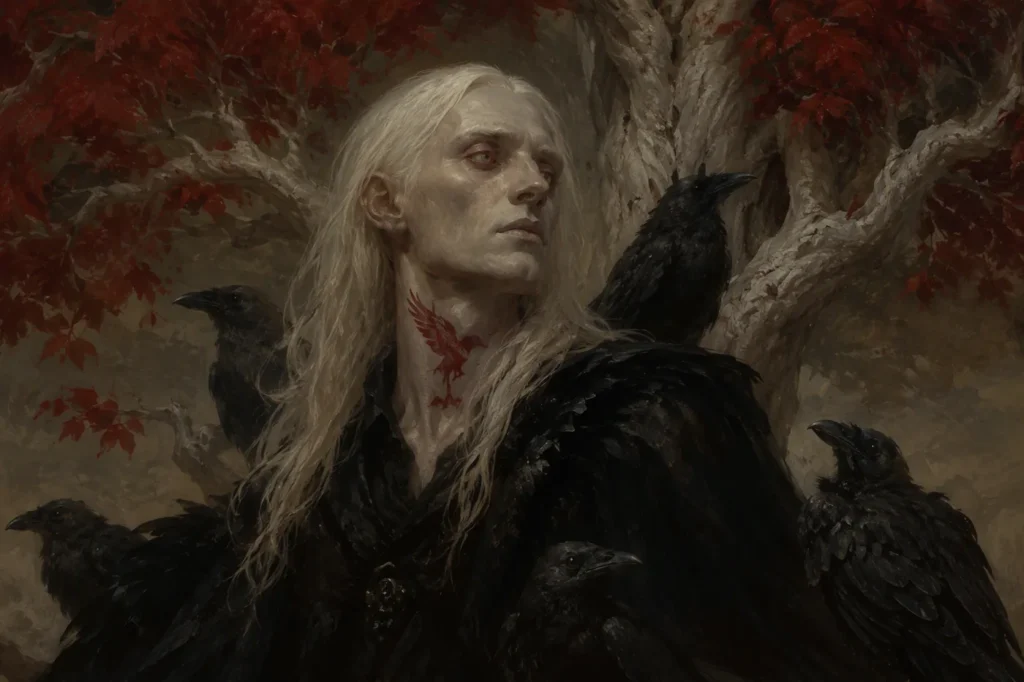
Brynden Rivers was one of Aegon IV’s “Great Bastards,” born in 175 AC to Melissa Blackwood, one of the king’s mistresses. He was an albino: milk-white hair, milk-white skin, red eyes, and a red birthmark running from his throat up one cheek that superstition read as a raven drawn in blood. The realm named him Bloodraven, and he leaned all the way into it — a white dragon on a black banner, a dark reputation, and a company of archers called the Raven’s Teeth.
Where his half-brother Bittersteel (Aegor Rivers, by Barba Bracken) was all muscle and grievance, Bloodraven was a sorcerer-flavored intelligence chief. The old Blackwood–Bracken feud ran straight through the royal bedchamber, and the two brothers hated each other their entire lives — over their mothers’ rivalry, over the crown, and over Shiera Seastar, their half-sister, whom both of them wanted: she shared Bloodraven’s bed but refused to marry him, and never chose Bittersteel. For the whole family, see the Great Bastards family tree.
The Redgrass Field: The Shot That Won the War
At the decisive battle of the First Blackfyre Rebellion in 196 AC, Bloodraven won the war the unglamorous way: his Raven’s Teeth took the high ground and shot down Daemon Blackfyre and his sons Aegon and Aemon. Arrows against the greatest sword alive. Bittersteel’s furious charge then cost Bloodraven an eye, though Bittersteel escaped the field — which is why “a thousand eyes, and one” is a joke with a body count. The battle is told in full in the Blackfyre family tree.
The Thousand Eyes
As Hand to Aerys I, and later Maekar I, Bloodraven ran the most feared intelligence apparatus Westeros ever had. The rhyme — “How many eyes does Lord Bloodraven have? A thousand eyes, and one” — was smallfolk theology: the man saw everything, possibly by magic, definitely by informers. He ended the Second Blackfyre Rebellion at Whitewalls in 212 AC by simply arriving with an army, and he kept the Blackfyre pretensions in a cage for two decades.
His methods were effective and appalling in equal measure, and the realm hated him for both. When the Great Council of 233 AC convened, the Blackfyre claimant Aenys arrived under promise of safe conduct — and Bloodraven had him killed. Legal? Arguably. The act of a state that plays by its own rules? Entirely. King Aegon V — Egg, newly crowned — arrested him for it and offered the Night’s Watch in place of execution. Bloodraven took the black in 233 AC, in the same party as Maester Aemon, and rose to Lord Commander of the Night’s Watch in 239.
Hand of the King, Master of Whisperers
Bloodraven’s rise did not stop at the battlefield. Aerys I named him Hand of the King in 209 AC, and he also ran the realm’s whisperers, which made him both the king’s chief minister and the head of its spies. He kept the office until around 233 AC, carrying it through Aerys I’s reign and into Maekar I’s. Through all of it he stayed loyal to the trueborn line, even though the Blackfyres were his own half-brother’s children.
His loyalty was tested in 212 AC at Whitewalls, where he arrested Daemon II Blackfyre at a tourney and ended the Second Blackfyre Rebellion before it had begun. By then the smallfolk were singing a song about him, A Thousand Eyes, and One.
The Great Council of 233 AC
Maekar I died in 233 AC, and the line of succession was a mess. Bloodraven, as Hand, called a Great Council to settle who would sit the Iron Throne. Aenys Blackfyre came to it under a promise of safe conduct, was arrested, and was executed. When Aegon V — Egg — took the crown, he arrested Bloodraven for Aenys’s death. The king offered him the Night’s Watch in place of the executioner’s block, and Bloodraven took the black.
It is one of the great ironies of the Targaryen era: the man who spent a lifetime protecting the throne from his own half-brother’s line was sent away by the king he had helped put there, over the killing of one of the last Blackfyres.
Lord Commander and the Wall
At the Wall, Bloodraven did not fade. The brothers elected him Lord Commander in 239 AC, and he held the post until 252 AC, when he vanished while ranging beyond the Wall and never returned. The histories do not say what happened to him. The books do: that is where Bran Stark eventually finds him.
The Three-Eyed Crow
Bloodraven disappeared beyond the Wall in 252 AC. And here is the franchise’s best-kept open secret, stated precisely: in the books, Brynden Rivers is the three-eyed crow — the ancient greenseer fused to a weirwood throne in the cave beyond the Wall, waiting decades to pass his sight to Bran Stark. The show kept the cave and the mentor but never named him; the books are unambiguous. The bastard spymaster of the Targaryen court ends as something older than any crown — which, for this site, is the point: the Targaryen family tree doesn’t just reach forward to Daenerys. One of its branches took root in a weirwood and grew eyes.
FAQ
Is Bloodraven the three-eyed crow?
In the books, yes — Brynden Rivers is the greenseer in the cave beyond the Wall who guides Bran. The show used the character but never confirmed his name on screen.
Is Bloodraven a Targaryen?
By blood, yes — a legitimized bastard son of Aegon IV Targaryen. He never used the Targaryen name; he fought to defend their throne, not claim it.
What happened to Bloodraven at the Wall?
He took the black in 233 AC (the alternative Aegon V offered to execution for killing a claimant under safe conduct), became Lord Commander of the Night’s Watch in 239 AC, and vanished beyond the Wall in 252 AC.
Why did Bloodraven and Bittersteel hate each other?
Everything: the ancient Blackwood–Bracken feud their mothers carried into the royal court, opposite sides of the Blackfyre Rebellion, and their shared love of their half-sister Shiera Seastar. Bittersteel took Bloodraven’s eye at the Redgrass Field.
Did Bloodraven have magic?
The books strongly imply it — greendreams, skinchanging (the “a thousand eyes” legend), and eventually the full power of the last greenseer. The Dunk and Egg era court whispered sorcery; the books confirm the whispers undersold it.
Did Bloodraven kill Daemon Blackfyre?
His archers did. The Raven’s Teeth, the company Bloodraven commanded, killed Daemon and his sons Aegon and Aemon at the Redgrass Field in 196 AC, and legend credits Bloodraven with guiding the arrows — sometimes with sorcery.
What did Bloodraven look like?
He was an albino, with milk-white skin, long white hair and red eyes. A red birthmark ran from his throat up the right side of his face, which people read as a raven. He lost an eye at the Redgrass Field and often left the socket uncovered.
Who was Hand of the King during the Dunk and Egg stories?
Bloodraven served as Hand from 209 AC under Aerys I and then Maekar I, until the Great Council of 233 AC.
Who was Bloodraven in love with?
His half-sister Shiera Seastar. He proposed to her several times and she refused each time.