Quick answer: Aegor Rivers — “Bittersteel” — was the legitimized bastard of Aegon IV and Barba Bracken: the sword-arm of the Blackfyre cause in three of its five rebellions, Bloodraven’s lifelong nemesis, and the founder of the Golden Company, one of the most famous sellsword armies in the world. If Bloodraven is the crown’s shadow, Bittersteel is the shadow of the crown that lost. See his place on the interactive Targaryen family tree.
Bracken Blood, Bitter Name
Aegor’s mother was Barba Bracken — and the Blackwood–Bracken feud, older than the Targaryen dynasty itself, came into the royal family with her. Barba’s fall from favor (when Melissa Blackwood replaced her in Aegon IV’s bed) and the Brackens’ subsequent humiliations set the tone: Aegor grew up cheated, furious, and magnificent at violence. The nickname tells you how he was experienced by others — nobody in the histories recalls a warm moment.
He was promised to Calla Blackfyre, Daemon Blackfyre’s daughter — his own half-niece — which would have bound him to the Blackfyre line by marriage as well as cause (whether the wedding ever took place isn’t recorded). Bittersteel didn’t want the throne. He wanted his brother Daemon’s line to have it, and he spent his life trying to put them on it. (The whole line is laid out in the Blackfyre family tree.)
Appearance and Temper
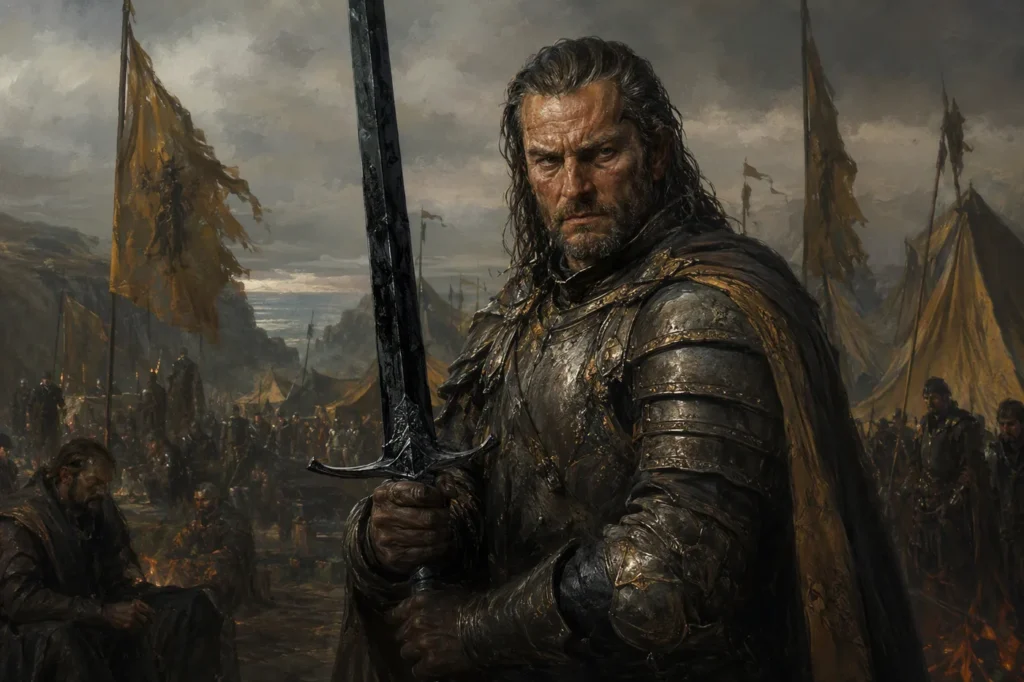
The sources describe a tall, lean, muscular man with black hair and purple eyes — a Valyrian trait from his Targaryen blood — who wore plain grey steel armor and black rings, with a horsehead crest on his helm. He was angry for most of his life, never smiled, and was easily offended, which later writers tend to blame on his Bracken blood. His banner showed a red stallion with black dragon wings, snorting fire, on a golden field.
The Redgrass Field: Vengeance in Retreat
At the Redgrass Field in 196 AC, Bittersteel fought on after Bloodraven’s archers shot down Daemon Blackfyre and his sons. He met Bloodraven in single combat and took his half-brother’s eye before the rout swallowed the Blackfyre army. Then he did the most consequential thing of all: instead of dying gloriously, he gathered the sword Blackfyre, Daemon’s surviving sons, and the shattered cause, and took them east into exile. The rebellion lost the war and kept its army — because Bittersteel refused to let it end.
The Golden Company
In exile, Bittersteel solved the mercenary problem permanently. After a year with the Second Sons, he left to form a company of his own, one that could unite the exiled lords — and give it a single obsessive selling point: the Golden Company never breaks a contract. “Our word is good as gold.” “Beneath the gold, the bitter steel.” Tales say that when the city of Qohor broke a contract with them, the company sacked it. Bittersteel died in the Disputed Lands in 241 AC, and commanded that his skull be boiled clean, dipped in gold, and carried before the company so that one day it would come home to Westeros. The captains-general who followed have kept the practice. The Blackfyre cause outlived him by design.
Here’s the thread most show fans don’t know they want: the Golden Company is in the Game of Thrones books — the army that lands in the Stormlands in A Dance with Dragons backing a boy claiming to be Aegon Targaryen. The show cut that plot entirely. Bittersteel’s creation is still moving pieces in the books’ endgame.
Bittersteel Timeline, 172–241 AC
| Year (AC) | Event |
|---|---|
| 172 | Born at King’s Landing to Barba Bracken; raised at Stone Hedge among the Brackens. |
| 184 | Legitimized with his siblings on Aegon IV’s deathbed. |
| 196 | Commands the right of Daemon’s army at the Redgrass Field; takes up Blackfyre, fights Bloodraven, and loses the battle. Flees to Tyrosh with the exiles. |
| c. 196–212 | Serves a year with the Second Sons, then founds the Golden Company. |
| 211–212 | Refuses to back Daemon II’s Second Blackfyre Rebellion. |
| 219 | Third Blackfyre Rebellion fails. Bittersteel is captured, Aerys I sends him toward the Wall, and his ship is intercepted — he escapes and rejoins the Golden Company. |
| 236 | Lands at Massey’s Hook for the Fourth Blackfyre Rebellion with Daemon III. The rebellion breaks at Wendwater Bridge, and he escapes again. |
| 241 | Dies in the Disputed Lands, aged 69. His skull is kept as a company relic. |
Captured, Sent to the Wall, and Rescued
The Third Blackfyre Rebellion in 219 AC ended badly for the rebels, and Bittersteel ended up a prisoner at the Red Keep. King Aerys I — Bittersteel’s half-nephew — chose not to execute him and sent him toward the Wall instead. The Golden Company intercepted the ship and freed him, and he soon returned to the Blackfyre cause in Essos. It is an odd fact of history that the man who was jailed by Aerys I owed his life to the mercenary company he had founded, and that the king who spared him left the Blackfyre cause alive for another war.
The Fourth Rebellion and the Last Years
In 236 AC, Bittersteel landed at Massey’s Hook with Daemon III Blackfyre, but the Fourth Blackfyre Rebellion was crushed at Wendwater Bridge. He escaped once more. The failure was the last big move of his life: he died in the Disputed Lands in 241 AC, aged 69. According to the sources, he died with a sword in his hand. His skull was kept by the Golden Company as a relic, and the captains-general who came after him kept the promise to carry it home to Westeros.
The Ledger of a Nemesis
| Bloodraven | Bittersteel | |
|---|---|---|
| Mother | Melissa Blackwood | Barba Bracken |
| Side in 196 AC | The crown (Daeron II) | The Blackfyres |
| Weapon | The Raven’s Teeth (archers) | The sword Blackfyre |
| Famous wound | Lost an eye — to Bittersteel | Gave it |
| Shiera Seastar | Her lover; she refused to marry him | Wanted her; she chose his brother |
| After the war | Spymaster, then the Wall | Exile; founded the Golden Company |
| Legacy | The three-eyed crow | An army that outlived him |
FAQ
Who founded the Golden Company?
Aegor “Bittersteel” Rivers, legitimized bastard of Aegon IV, in exile in Essos after the First Blackfyre Rebellion. Its founding promise — never breaking a contract — was his fix for the sellsword trade’s famous faithlessness.
Why did Bittersteel hate Bloodraven?
Their mothers were Blackwood and Bracken — the oldest blood feud in Westeros — and they inherited it into the royal family. The Blackfyre Rebellion (opposite sides) and their rivalry over their half-sister Shiera Seastar finished the job.
Is the Golden Company in the Game of Thrones books?
Yes, prominently — in A Dance with Dragons they land in Westeros supporting a claimant. The HBO show used the company’s name but not its book storyline.
Did Bittersteel ever return to Westeros?
In arms, repeatedly — he fought in the First, Third and Fourth Blackfyre Rebellions (he refused to back the Second), was captured in 219 AC and sentenced to the Wall, but escaped when the Golden Company attacked his ship. He died in the Disputed Lands in 241 AC and ordered his skull dipped in gold to lead the Golden Company home someday.
Was Bittersteel a good fighter?
One of the best of his era — a battlefield commander whose single-combat record includes taking Bloodraven’s eye at the Redgrass Field. What he never was, in three tries, was lucky.
Did Bittersteel ever sit the Iron Throne?
No. He never wanted it for himself. He spent his life trying to put Daemon’s descendants, the Blackfyres, on it.
What did Bittersteel look like?
Tall, lean and muscular, with black hair and purple eyes. His armor was plain grey steel and black rings, and his helm had a horsehead crest.
Why did Aerys I send Bittersteel to the Wall?
After the Third Blackfyre Rebellion in 219 AC, Aerys I spared Bittersteel and sent him toward the Wall in place of execution. The Golden Company intercepted his ship and freed him.
How did Bittersteel die?
He died in 241 AC at the age of 69 in the Disputed Lands, reportedly with a sword in his hand. The Golden Company kept his skull as a relic.