Quick answer: Viserys I Targaryen (reigned 103-129 AC) was the fifth Targaryen king: a warm, conflict-averse ruler chosen by the Great Council of 101 AC, who named his daughter Rhaenyra his heir in 105 AC, remarried Alicent Hightower in 106 AC, and died in 129 AC without ever resolving the rivalry between the two. His refusal to choose between his daughter and his sons is the root of the Dance of the Dragons.
The Great Council’s Choice
Viserys took the throne through the only democratic process Westeros ever tried. When old King Jaehaerys I outlived his sons, he called the Great Council of 101 AC at Harrenhal. More than a thousand lords attended over roughly half a year, and the council weighed fourteen claims. Viserys, the eldest son of Prince Baelon, won. His chief rival was Laenor Velaryon, the young son of Rhaenys, the Queen Who Never Was. Rhaenys herself, and her daughter Laena, were passed over because of their sex. The maesters never published the vote, but it was rumored that Viserys won twenty to one.
The deeper result was a precedent. Archmaester Gyldayn writes that the council set an “iron precedent” that the Iron Throne could not pass to a woman or to a man descended through a woman. That precedent was the legal weapon the Greens would later use against Viserys’s own daughter. For the war it fed, see who won the Dance of the Dragons.
The Succession He Built and Refused to Defend
Viserys’s tragedy plays out in a few decisions, each reasonable on its own.
He named Rhaenyra his heir (105 AC). His first wife, Aemma Arryn, died in 105 AC giving birth to a son, Baelon, who lived only a day. After mourning, Viserys held a ceremony declaring Rhaenyra his heir and Princess of Dragonstone, against the precedent set at the Great Council. His brother Daemon, until then his heir presumptive, left court in a fury. The series dramatizes this as Daemon being named “heir for a day”; in the books he was simply the next in line until Rhaenyra was named.
He remarried (106 AC). Viserys married Alicent Hightower, the daughter of his Hand, Otto. They had four children: Aegon (107 AC), Helaena (109 AC), Aemond (110 AC) and Daeron (113 AC). That created a second claimant who was a son, and a court party built around him. In 109 AC Viserys dismissed Otto Hightower as Hand for raising the succession once too often, but he never actually fixed the problem.
He refused to choose. For two decades Viserys treated the succession as settled while letting his sons by Alicent grow up as princes of the blood. Two courts formed under one roof, and the king asked everyone to get along.
The Hand That Never Healed
In 126 AC Viserys ordered the tongues removed from those spreading rumors about Rhaenyra’s sons, then cut his hand to the bone on the Iron Throne. The wound festered, and Maester Gerardys removed two of his fingers. Viserys never sat the Iron Throne again. It is the clearest sign of how the king’s body, like his kingdom, was failing slowly in front of everyone.
Death and the Green Coup
Viserys died in his sleep in Maegor’s Holdfast on the third day of the third moon of 129 AC, aged fifty-two. The sources do not state a cause. He had decreed Rhaenyra his heir, but Queen Alicent concealed his death for about a week while the Greens moved to crown Aegon II. The Dance of the Dragons began almost at once.
Viserys in House of the Dragon
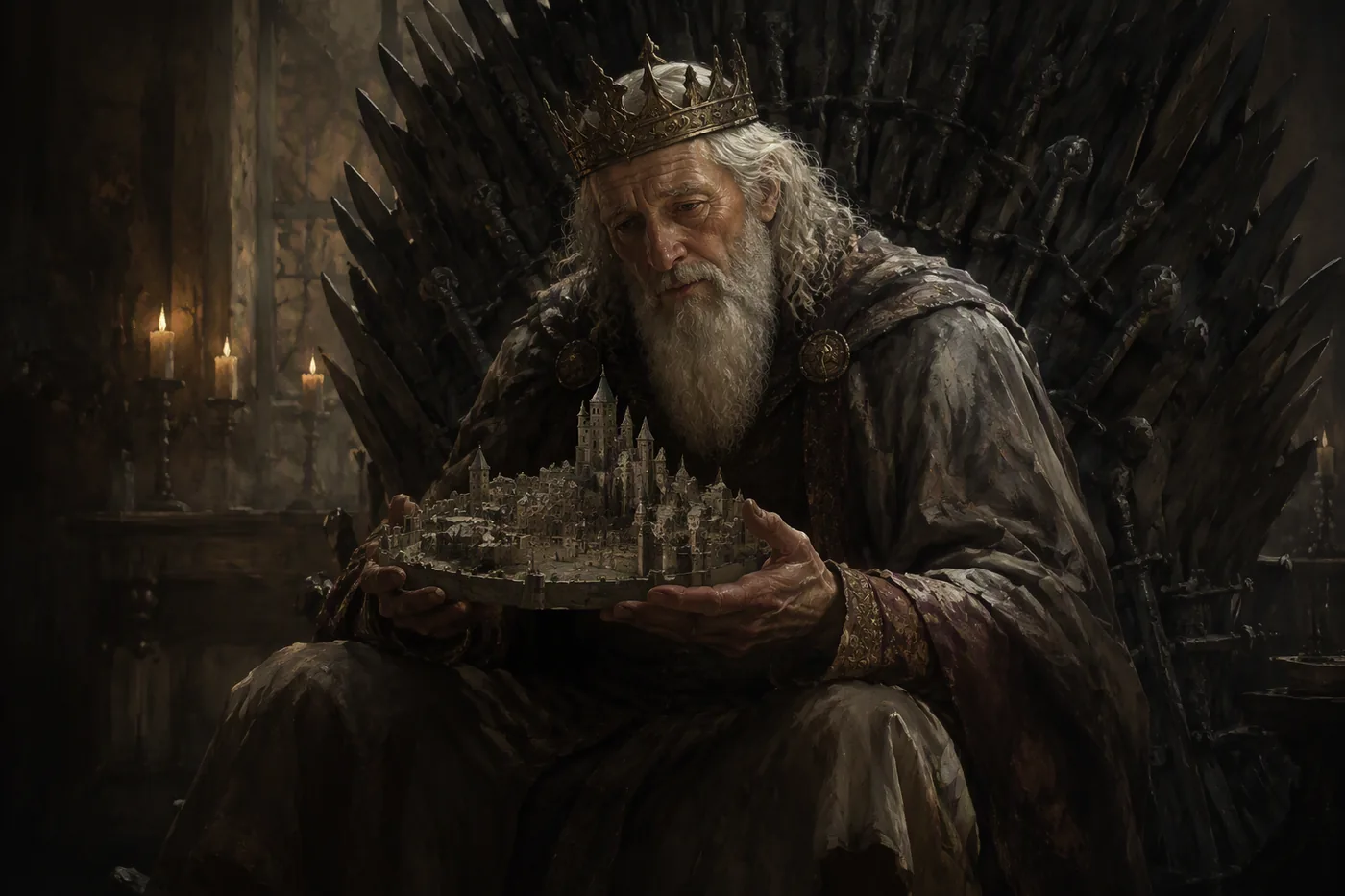
The series adds several details that are not in Fire & Blood. It makes Viserys a dragon dreamer who inherits the secret of Aegon the Conqueror’s prophecy, gives him a model of Old Valyria that he tends obsessively, and ends his life with a wasting disease. In the show he tells Rhaenyra about the prophecy on his deathbed, and Alicent mishears the name “Aegon” as an order to crown her son. The books have no such misunderstanding: Viserys never named anyone but Rhaenyra. If you are tracing the family relationships, the House of the Dragon family tree guide and the interactive Targaryen family tree show where Viserys sits at the fork of the whole war.
Viserys I at a Glance
| Detail | Record |
|---|---|
| Reign | 103-129 AC (fifth Targaryen king) |
| Chosen by | Great Council of 101 AC, over Laenor Velaryon |
| Wives | Aemma Arryn (married 93 AC, died 105 AC) and Alicent Hightower (married 106 AC) |
| Children | Rhaenyra (by Aemma); Aegon, Helaena, Aemond and Daeron (by Alicent) |
| Injury | Cut his hand on the Iron Throne in 126 AC; lost two fingers |
| Died | 129 AC, in his sleep, aged 52 |
FAQ
Why did Viserys name Rhaenyra his heir?
After Queen Aemma died in 105 AC and the only son she bore died a day later, Viserys had no living legitimate son. He declared Rhaenyra, his eldest and only living child of that marriage, his heir at a formal ceremony and made her Princess of Dragonstone.
Did Viserys want Aegon to be king?
No. In the books Viserys never changed his decree, and Rhaenyra remained his declared heir to the end. The series invents a deathbed misunderstanding in which Alicent mishears the name “Aegon” as a change of heir.
What was the Great Council of 101?
A kingdom-wide council at Harrenhal called by King Jaehaerys I to settle his succession. It chose Viserys over Laenor Velaryon, and passed over Rhaenys and Laena because they were women, setting the precedent the Greens later used against Rhaenyra.
How did Viserys I die?
He died in his sleep in Maegor’s Holdfast in 129 AC, aged 52. No cause is given. His hand had been wounded on the Iron Throne in 126 AC and he never sat it again.
Was Viserys a bad king?
He is remembered as a kind, generous man and an adequate king whose one catastrophic failure was succession. He named a female heir against the council precedent and then never enforced that choice against his second family.
Related Pages
- Rhaenyra Targaryen
- Aegon II Targaryen
- Daemon Targaryen
- Rhaenys Targaryen, the Queen Who Never Was
- Who won the Dance of the Dragons
- House of the Dragon family tree guide