
Aegon I Targaryen, known as Aegon the Conqueror, was the Lord of Dragonstone who, with his sister-wives Visenya and Rhaenys and their three dragons, conquered six of the Seven Kingdoms between 2 BC and 1 AC and founded the dynasty that held the Iron Throne for nearly three centuries. Every king, war and dragon on this site descends from him, and from one decision to look west.
Who Was Aegon the Conqueror?
Aegon was born on Dragonstone in 27 BC, the son of Lord Aerion Targaryen and Lady Valaena Velaryon. He grew up with two sisters, Visenya, the elder, and Rhaenys, the younger, and he would marry both of them, as Valyrian custom allowed. His family had lived on Dragonstone for more than a hundred years, ever since his ancestors fled Valyria ahead of the Doom, and for all that time they had been content to be dragonlords on a rock in the Narrow Sea. Aegon was the one who decided they should be more.
By the time he was a grown man he held Dragonstone, owned three dragons, and had a clear idea of what to do with them. The old Targaryen story is told in full in our Targaryen origins guide; the short version is that Aegon is the point where a refugee family becomes a royal house.
The Lord Who Looked West
The histories do not agree on a single reason Aegon turned west. What they do agree on is the situation he saw: Westeros was divided into seven rival kingdoms, none of which had ever faced a dragon, while the Free Cities across the sea were strong enough to be dangerous and too far gone from Valyrian rule to be taken back. Dragonstone, meanwhile, sat at the mouth of Blackwater Bay with a clear view of the mainland.
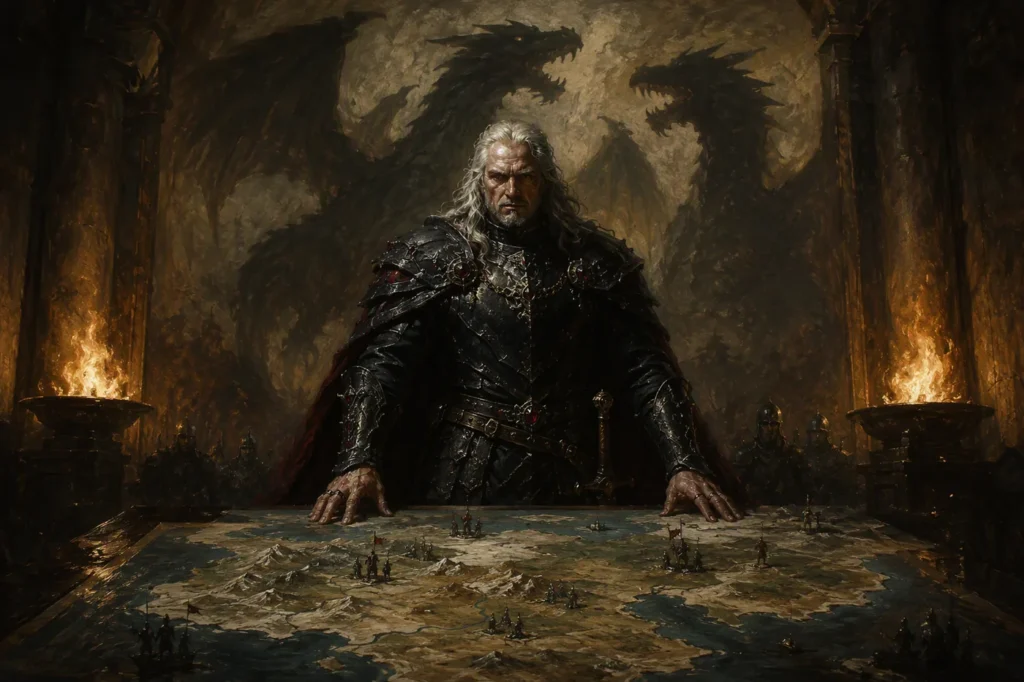
Aegon had the Painted Table made, a great wooden map of Westeros with no borders painted on it, because he believed the continent should be one realm. According to the stories he was at that table, telling his grandsons about the Conquest, when he died. Whatever else is embellished, the intent is clear. He was not raiding. He was founding something.
Two Years, Three Dragons
Aegon landed at the mouth of the Blackwater Rush in 2 BC with fewer than 1,600 men and three dragons: his own Balerion, Visenya’s Vhagar and Rhaenys’s Meraxes. He raised a wooden fort, the Aegonfort, on the hills where King’s Landing would one day stand, and let each kingdom learn its own lesson. Harrenhal learned fire. The Field of Fire ended two kings in an afternoon. Torrhen Stark rode south with the North’s host, saw what the dragons could do and knelt, earning the name the King Who Knelt. The Vale surrendered to Visenya, and the Reach surrendered in the person of Harlan Tyrell, the steward of Highgarden.
Aegon was crowned twice. Visenya set a Valyrian steel circlet on his head at the Aegonfort, and in 1 AC the High Septon anointed him at the Starry Sept in Oldtown. Westerosi history counts its years from that second coronation. Only Dorne refused the logic of the whole campaign: it would not mass for battle, would not hold its castles and would not stand still to be burned. The full account, kingdom by kingdom, is in Aegon’s Conquest explained, and the battle that decided it is covered in the Field of Fire.
The King He Chose to Be
The man who ruled for thirty-seven years after the Conquest was not just a warlord. Aegon kept the conquered kingdoms’ lords and laws, made his peace with the Faith, and named Orys Baratheon, his closest companion, as the first Hand of the King (see Orys Baratheon). He is also remembered for the Iron Throne, forged from the swords of his defeated enemies and, by tradition, built tall and jagged on purpose. “A king should never sit easy,” Aegon is said to have remarked.
His reign was not untroubled. After an attack on the king left him wounded, Visenya had the Kingsguard established to protect him, and the First Dornish War dragged on for nine years, from 4 AC to 13 AC, costing him Rhaenys. Their story is told in Visenya and Rhaenys. Aegon himself died in 37 AC on Dragonstone, at the age of about sixty-three, of a stroke.
Wives, Sons and the First Succession Problem
Aegon had two sons. Aenys, born in 7 AC, was Rhaenys’s boy and became the second king. Maegor, born to Visenya on Dragonstone in 12 AC, grew into the strongest warrior in the family and, eventually, the dynasty’s first tyrant. Aenys was gentle and ill-suited to the job, Maegor was formidable and cruel, and their mothers did not hide which of them they favored. The first succession crisis in Targaryen history was baked into the Conqueror’s own household.
Fifteen of the sixteen Targaryen kings descend from Aegon and Rhaenys through Aenys, the exception being Maegor. Everything that follows, from the Blackfyre Rebellion to the Dance, is a commentary on the seam that ran through Aegon’s family from the start. You can follow every branch on the full family tree.
FAQ
Who was Aegon the Conqueror?
Aegon I Targaryen, Lord of Dragonstone, who conquered six of the Seven Kingdoms between 2 BC and 1 AC with his sister-wives Visenya and Rhaenys and their dragons Balerion, Vhagar and Meraxes. He founded the Targaryen dynasty and was anointed king in Oldtown in 1 AC.
Did Aegon conquer all seven kingdoms?
No, only six. Dorne refused pitched battle and was never conquered. It joined the realm nearly two centuries later, through marriage rather than war, during the reign of Daeron II.
Who were Aegon I’s children?
Two sons: Aenys, born to Rhaenys in 7 AC, and Maegor, born to Visenya. Aenys succeeded his father in 37 AC and Maegor took the throne after him in 42 AC.
How did Aegon the Conqueror die?
He died on Dragonstone in 37 AC after a stroke, at about sixty-three. Tradition says he was at the Painted Table, telling his grandsons about the Conquest.
What is the Painted Table?
A great wooden map of Westeros with no borders painted on it, made because Aegon believed the continent should be a single realm. It appears in Game of Thrones in the council chamber on Dragonstone.