House of the Dragon Season 3 adapts the stretch of Fire & Blood from the Battle of the Gullet to Tumbleton, and the biggest changes are Nettles becoming Rhaena, Hugh Hammer being spared the betrayal that defines him in the book, and the two Tumbletons collapsing into one battle. Here is every major change, in the format that matters: what the book says, what the show does, and why it matters.
How to Read the Book First
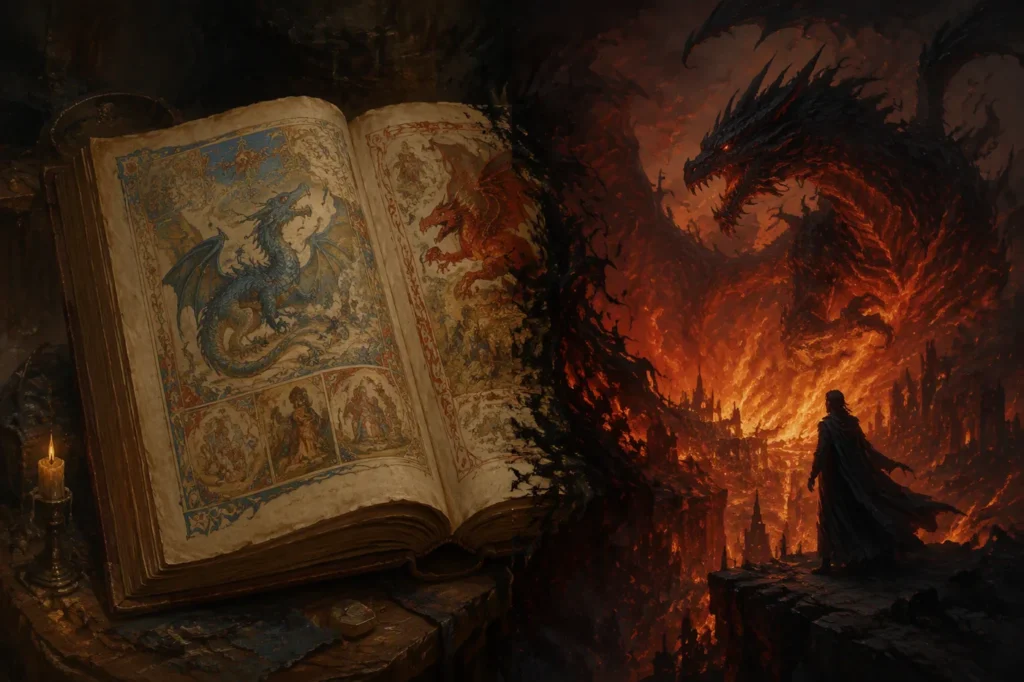
Quick calibration: Fire & Blood is not a novel. It is an in-world history by Archmaester Gyldayn, stitching together unreliable sources, chiefly the septon Eustace, the maester Munkun and the fool Mushroom, who lies for sport. When the show and the book disagree, it is not always a change. Sometimes the show is choosing which source to believe.
The Season 3 Change List
- 1. Nettles becomes Rhaena
Book: a sixteen-year-old dock-born bastard named Nettles claims the wild dragon Sheepstealer by leaving him a fresh sheep every morning, and later becomes Daemon’s companion at Maidenpool.
Show: Nettles is cut. Rhaena Targaryen claims Sheepstealer in the premiere, and a Vale gossip’s passing remark about a “nettles” in the mountains is the only wink. Showrunner Ryan Condal has said the choice keeps the focus on the Targaryen family.
Why it matters: Nettles is the canon’s strongest evidence that dragonriding was never really about Valyrian blood. Giving the dragon to a Targaryen quietly removes that argument. - 2. Hugh Hammer stops being a betrayer
Book: Hugh and Ulf, the Two Betrayers, both turn on Rhaenyra at the First Battle of Tumbleton and are rewarded by the Greens.
Show: Only Ulf betrays. Hugh disobeys orders to reach Tumbleton, arrives late, and finds his wife Kat dead.
Why it matters: The book’s Hugh is a vain, violent man made by ambition. The show’s is a grieving husband. The tragedy is real, but it removes the lesson the Dance learned about seeds. - 3. Two Tumbletons become one
Book: the Greens win the First Battle through the Treasons, sack the town, and are shattered weeks later by Addam of Hull in a night attack.
Show: Ormund holds Tumbleton, and Daemon attacks it in the finale. Ulf’s dragon burns both armies, Roderick Dustin mortally wounds Ormund (as in the book), and the Blacks fall back.
Why it matters: In the book Tumbleton is a Green victory that destroys itself. In the show it is still an open wound for both sides, and the Second Tumbleton remains to come. - 4. Daeron the Daring
Book: a gentle boy of about fifteen, squire to Ormund in Oldtown, who saves Ormund’s army at the Honeywine on Tessarion and dies at the Second Tumbleton in one of three accounts.
Show: Ormund grooms him as a king in waiting, with gold coins stamped with his face, Tessarion chained in a sept, and a false Daeron used as a decoy. His fate is left open in the finale.
Why it matters: The book’s Daeron is a tragic bystander. The show makes him a political instrument, which changes who the real villain at Tumbleton is. - 5. Aemond, Vhagar and Alys
Book: Aemond rules as Prince Regent, retakes Harrenhal, spares Alys Rivers, and dies with Vhagar over the God’s Eye in 130 AC.
Show: Aemond sits on the Iron Throne in the premiere, sees Vhagar go missing, and is last seen at Harrenhal with Alys, who reveals she is over a hundred years old and cursed. Aegon finds him and they plan to find Vhagar.
Why it matters: The God’s Eye duel is a pillar of the book’s endgame. Without Vhagar, the show has to find a new way to get there. - 6. Helaena’s death moves up
Book: Helaena jumps from her window in Maegor’s Holdfast days after Daemon’s death, and the motive is disputed. A pregnancy is only Mushroom’s claim, which Gyldayn rejects.
Show: She is pregnant, held captive by Rhaenyra, and jumps during the Tumbleton episode.
Why it matters: It turns an ambiguous book scene into an indictment of Rhaenyra’s rule. - 7. Jacaerys at the Gullet
Book: Jacaerys dies in 130 AC when Vermax crashes into a burning Triarchy galley and Myrish crossbow quarrels strike him as he clings to the wreckage.
Show: Vermax is hit by a scorpion bolt and drowns, and Jace is killed by Triarchy bowmen, much as in the book.
Why it matters: One of the season’s closest adaptations, kept with new emotional beats around Rhaenyra. - 8. Criston Cole at the Butcher’s Ball
Book: Criston is shot with arrows by Robb Rivers’ archers after he offers to yield and is refused.
Show: He is shot by Alysanne Blackwood before a planned duel at the Butcher’s Ball.
Why it matters: The setting is faithful, the killer is not. It gives a Blackwood the moment the book gives to the riverlands’ archers. - 9. Rhaenyra the Chosen
Book: nothing like it. By the end the book’s Rhaenyra is an unpopular and increasingly despotic queen.
Show: She tells the smallfolk she is the Prince That Was Promised, a speech Condal says is not in the book.
Why it matters: It makes her harsher and more self-mythologizing than the book ever does.
The Verdict
Season 3 keeps the spine of the book: the Gullet, the fall of King’s Landing, Tumbleton and the dragonseeds. It makes its changes in the gaps the fake-history format leaves open. For where every faction stands after the finale, see our Season 3 ending explained. For the book’s account of the battle itself, see Battle of Tumbleton explained.
FAQ
Is HOTD Season 3 faithful to Fire & Blood?
Broadly yes. It keeps the Gullet, the fall of King’s Landing, the dragonseeds and Tumbleton, but it condenses characters and timelines and changes several key beats, including Nettles, Hugh Hammer, Daeron, Aemond and Helaena.
What did HOTD Season 3 change from the book?
The biggest changes are Nettles’ role going to Rhaena, Hugh Hammer not betraying Rhaenyra, the two Battles of Tumbleton merging into one, Daeron being groomed as a king, Vhagar going missing, and Helaena’s death moving earlier.
Is Nettles in House of the Dragon?
No. Her story has been given to Rhaena Targaryen, and the show has only winked at the name.
Why does Fire & Blood contradict itself?
Because it is written as an in-world history from conflicting sources. The unreliability is the design, and the show uses it as creative room.
Should I read Fire & Blood after Season 3?
Yes. The Dance chapters read very differently once you know the faces, and the book’s Second Tumbleton is the story Season 4 still has to tell.